Career Options After 12th in India 2026: Complete Stream-Wise Guide for Students
Completing Class 12 is a massive milestone, but it often brings a lot of confusion: "What should I do next?" In India's rapidly evolving job market, your choice after school shapes your professional path. This comprehensive guide simplifies career planning for Indian students. Whether your background is in Science (PCM/PCB), Commerce, or Arts (Humanities), we break down top degree programs, competitive exams, and upcoming technical skills. Read on to explore traditional paths alongside high-growth fields like AI, data science, and digital marketing to find your ideal career fit.
Table of Contents
- The Changing Career Landscape in India
- 1. Career Options After 12th Science (PCM)
- 2. Career Options After 12th Science (PCB)
- 3. Career Options After 12th Commerce
- 4. Career Options After 12th Arts / Humanities
- At a Glance: Course Duration, Selection Exams, and Earning Scope
- 5. Emerging Skills and Alternative Career Pathways
- Essential Step-By-Step Guide to Pick the Best Career
- Important Links for Career Planning
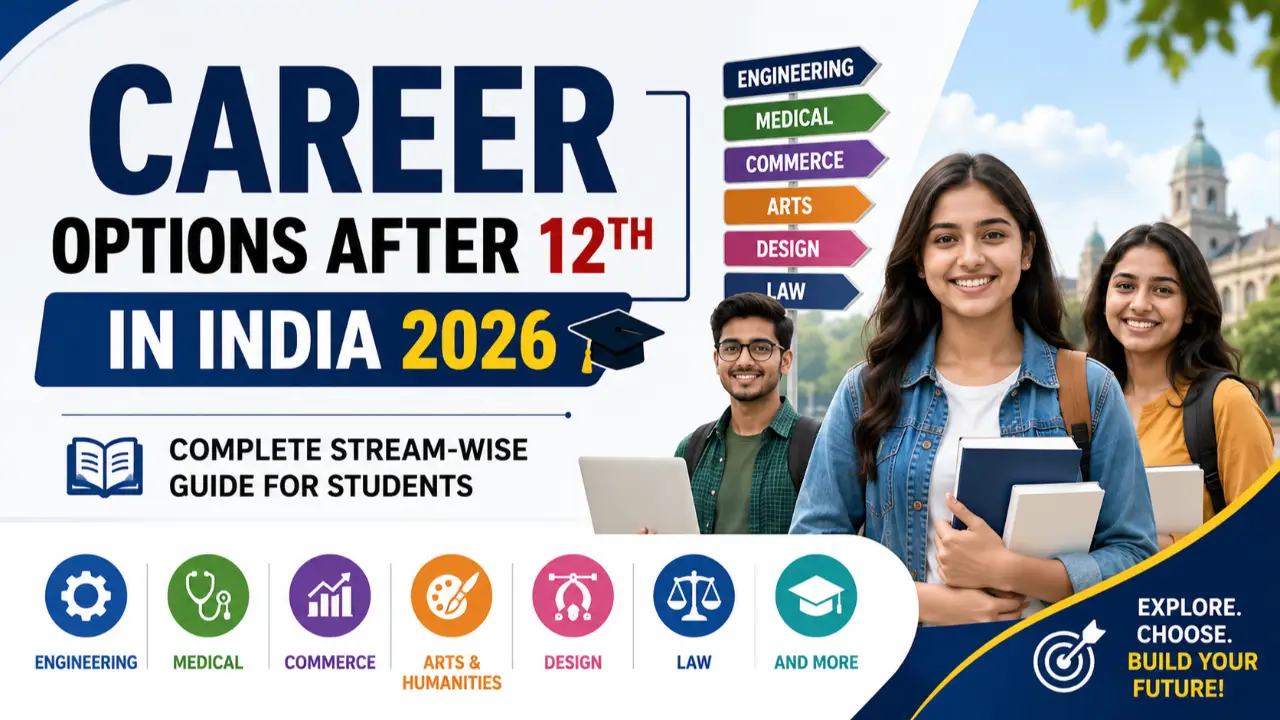
The Changing Career Landscape in India
Gone are the days when engineering and medicine were the only stable career choices after school. Today, India's economic growth and technological expansion have created highly rewarding roles in management, design, digital media, and data analytics. Choosing the right course requires aligning your school stream with your natural skills and long-term career goals. Let us look at the finest options available across various streams.
1. Career Options After 12th Science (PCM)
Students with Physics, Chemistry, and Mathematics (PCM) have a strong analytical base. Beyond standard engineering, the tech sector offers several specialized high-paying career paths:
- B.Tech / B.E. (Engineering): The primary choice for PCM students. While core fields like Mechanical, Civil, and Electrical remain popular, modern specializations like Computer Science, Artificial Intelligence (AI), Machine Learning (ML), and Cloud Computing are in very high demand. Entry requires clearing exams like JEE Main or state-level CETs.
- B.Sc in Data Science / Computer Science: A great 3 to 4-year alternative to engineering. It focuses on programming languages, data analytics, and database management.
- Architecture (B.Arch): A 5-year professional program combining structural design and creative planning. Admission relies on clearing the NATA or JEE Paper 2 exams.
- National Defence Services (NDA): Clear the UPSC NDA entrance exam to join the Indian Army, Navy, or Air Force. This provides excellent job security and a prestigious career path right after school.
- Aviation & Merchant Navy: High-paying commercial fields. You can pursue a Commercial Pilot License (CPL) training program or join a B.Sc in Nautical Science.
2. Career Options After 12th Science (PCB)
For students with Physics, Chemistry, and Biology (PCB), healthcare, research, and life sciences offer fulfilling paths:
- Medical Degrees (MBBS / BDS): The most respected path in healthcare. Clearing the highly competitive NEET-UG exam is mandatory to secure seats in government and private medical institutions.
- Allied Medical Sciences (BAMS / BHMS / B.U.M.S): Offers great potential in traditional Indian medicine systems like Ayurveda and Homeopathy.
- B.Sc Nursing & Physiotherapy (BPT): Crucial clinical fields experiencing massive infrastructural expansion in private and public healthcare systems.
- B.Pharm (Pharmacy): A 4-year program that prepares you for roles in pharmaceutical manufacturing, clinical research, and medical labs.
- Biotechnology & Microbiology: Ideal for research-oriented minds. These degrees cover corporate biochemical research, genetics, and vaccine development.
3. Career Options After 12th Commerce
Commerce students develop strong foundations in finance, business economics, and corporate governance:
- Chartered Accountancy (CA): Regarded as the premier finance credential in India, managed by the ICAI. It involves clearing the CA Foundation, Intermediate, and Final exams alongside practical articleship training.
- BBA (Bachelor of Business Administration): A great choice for developing management, human resource, and corporate operational skills. Securing admission to top institutions via exams like IPMAT can lead to strong career prospects.
- Company Secretary (CS): Handled by the ICSI, this professional certification turns you into a key legal advisor and compliance specialist for corporate bodies.
- B.Com (Hons) / B.Com: A foundational accounting degree that provides an excellent base for pursuing an MBA, M.Com, or banking entrance exams later.
- Actuarial Science: A highly specialized field for students who excel in statistics and mathematics. It focuses on risk assessment for insurance and investment firms.
4. Career Options After 12th Arts / Humanities
The Arts stream offers diverse choices across creative, legal, media, and administrative fields:
- Integrated Law (BA LLB / BBA LLB): A popular 5-year combined professional degree. Securing high scores in the national CLAT or AILET exams grants access to National Law Universities (NLUs) for corporate or criminal law practices.
- Journalism & Mass Communication (BJMC): Perfect for careers in digital journalism, corporate public relations, television news processing, and advertising.
- Bachelor of Design (B.Des): Ideal for creative minds looking to enter fashion design, interior layout planning, or digital UX/UI design via exams like NID DAT or NIFT.
- BA Specializations (Psychology / Economics / Political Science): Establishes a strong foundation for higher education, research, counseling, or teaching careers.
- Civil Services Preparation: Many Arts students begin targeted preparation for the UPSC Civil Services Exam (to become an IAS, IPS, or IFS officer) during their graduation years.
At a Glance: Course Duration, Selection Exams, and Earning Scope
Here is a simple summary table comparing prominent pathways across various streams in India:
| Course Name | Primary Stream | Duration | Key Selection Entrance | Average Starting Pay Scale |
|---|---|---|---|---|
| B.Tech (CS / IT) | Science (PCM) | 4 Years | JEE Main / Advanced / State CETs | Rs. 4.5 to 12 Lakh per annum |
| MBBS | Science (PCB) | 5.5 Years | NEET-UG | Rs. 6.0 to 12 Lakh per annum |
| CA Course | Commerce / Any | 4.5 Years | CA Foundation Exam | Rs. 7.0 to 15 Lakh per annum |
| Integrated LLB | Arts / Any | 5 Years | CLAT / AILET / State Law Exams | Rs. 4.0 to 10 Lakh per annum |
| BBA / B.Com | Commerce / Any | 3 Years | CUET-UG / IPMAT / Merit Bases | Rs. 3.0 to 7 Lakh per annum |
5. Emerging Skills and Alternative Career Pathways
If you prefer short-term vocational courses or want to develop independent freelancing skills, these fields are open to students from all streams:
- Digital Marketing: Covers SEO, social media management, brand promotion, and running online ad campaigns. This offers excellent growth potential for creative minds.
- UI/UX Designing & Animation: Focuses on designing app interfaces, graphic assets, website layouts, or media content.
- Coding Bootcamps (Full-Stack Web Development): Intensive 6 to 12-month certification programs that help you build software development skills without a formal engineering degree.
Essential Step-By-Step Guide to Pick the Best Career
To avoid making hasty choices under peer pressure, follow these simple checkpoints:
- Analyze Your Interests: Evaluate whether you enjoy working with numbers, coding logic, health sciences, creative art forms, or administrative tasks.
- Research Entrance Exams: Check critical application dates for exams like CUET, JEE, NEET, or CLAT carefully.
- Evaluate Course Costs: Consider parameters like tuition fee requirements and college hostel stay budgets before finalizing your choices.
- Look at Long-Term Scope: Focus on building practical skills alongside your college degrees to stay competitive in the job market.
Important Links for Career Planning
| Official NTA Entrance Portal | nta.ac.in |
| UGC Official Updates Portal | ugc.gov.in |
Last verified on: July 1, 2026
Frequently Asked Questions
Q1: Which course has the highest salary potential in India after Class 12?
Ans: Traditional professional courses like MBBS, B.Tech (Computer Science/AI), and Chartered Accountancy (CA) command excellent packages. Emerging domains like Data Science and specialized Corporate Law also offer high starting salaries ranging from Rs. 6 to 15 Lakh per annum.
Q2: Can a Commerce or Arts student apply for technical courses like Data Science or Digital Marketing?
Ans: Yes. While a B.Tech requires a Science (PCM) background, programs like a BBA in Digital Marketing, a BCA, or professional certifications in Data Analytics are open to students from all streams.
Q3: What is the significance of the CUET exam for students after the 12th standard?
Ans: The Common University Entrance Test (CUET-UG) is a centralized national exam. Clearing it allows you to secure admission to prestigious central universities across India (like Delhi University, BHU, and JNU) for regular BA, B.Sc, and B.Com honors programs.
Q4: Are there career options available after Class 12 that do not require clearing JEE or NEET?
Ans: Yes. If you prefer paths outside engineering or medicine, you can look into alternative options like B.Sc Biotechnology, B.Pharm, BBA, Integrated Law (CLAT), Bachelor of Design (B.Des), or Digital Marketing certifications.